
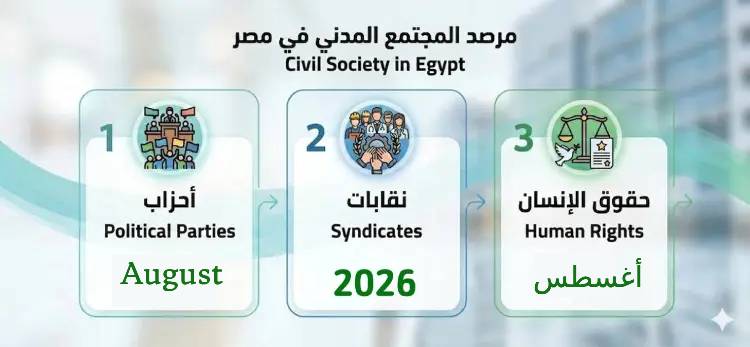
Section One: Political Parties
Introduction
Throughout August 2026, there was a clear divergence in political parties’ stances on ongoing issues and events. Pro-government parties, for example, focused primarily on service-oriented and grassroots activities, with little attention to incidents and developments affecting citizens and their daily lives, particularly accidents that claimed the lives of dozens of people on the roads.
By contrast, opposition parties and the civil movement paid greater attention to these incidents and issued statements criticizing road and transportation conditions, as well as workers’ conditions.
- Nation’s Future Party
The Nation’s Future Party’s (Mostaqbal Watan) activities centered primarily on its service-oriented and charitable role rather than its political and legislative functions. Most of its activities zeroed in on providing local services and launching community initiatives, with relatively limited political or parliamentary engagement.
The Party focused on the so-called “My Country is Beautiful” initiative to clean streets in Kafr El Sheikh. It also established the “Academy of Culture and Arts” in Gharbia Governorate to develop talents through a diverse range of cultural and artistic activities and workshops.
In addition, the Party organized medical checkups for children in Basyoun District, Gharbia Governorate. Furthermore, it organized an exhibition offering school supplies at discounted prices in Port Said.
- Homeland Protectors Party
The activities of the Homeland Protectors Party (Humat Al Watan) ranged across service-oriented and community initiatives and limited legislative activities. The Party organized events honoring outstanding students and announced financial support for the construction of a pedestrian bridge in Minya. One of its members also submitted a proposal to establish an investment fund for Egyptians abroad. In addition, the Party voiced its objection to a decision concerning accommodation for female Al-Azhar University students in Giza Governorate.
- August 2: Dr. Mokhtar Hemam Morsi, MP, Deputy Chair of the Housing Committee at the House of Representatives and Secretary-General of the Homeland Protectors Party in Sohag, submitted a proposal to establish a “National Investment Fund for Egyptians Abroad” to support national projects.
- August 15: The Homeland Protectors Party announced a donation of EGP 1 million to contribute to the construction of a new pedestrian bridge in Samalout, Minya Governorate, in response to demands from residents of the East of the Canal district following the closure of the old bridge built over the Ibrahimiyah Canal.
- August 16: The Saf District Secretariat of the Homeland Protectors Party in Giza Governorate expressed deep concern over a decision by the Central Administration of University Cities at Al-Azhar University in Cairo, headed by Osama Tawfik, stipulating that female student from Giza Governorate would not be accommodated in university cities this year, citing the need for maintenance work in some buildings.
- National Front Party
During August 2026, the National Front Party’s (Algabha Alwataniya) activities focused on service-oriented, community, and organizational issues. These included launching outlets selling food commodities at discounted prices, providing financial assistance to the families of victims and those injured in the Ismailia accident, and continuing training and capacity-building programs for young cadres preparing to serve on local councils in Menoufia Governorate.
- August 11: The Party announced that it would provide financial assistance to the families of victims and those injured in the Ismailia accident, with the aim of supporting those affected and alleviating the consequences of the incident.
- August 15: The Qalyubia Secretariat of the National Front Party began operating mobile and fixed outlets offering food commodities to citizens at discounted prices.
4. Justice Party
During August 2926, the activities of the Justice Party (El-Adl) focused on economic, social, and oversight issues. The Party criticized the decision to increase electricity prices and condemned the Ismailia workers’ transportation accident, holding the government responsible for the recurrence of such incidents. It also made use of its parliamentary tools by submitting questions to the government concerning occupational safety in the petroleum sector and problems within the social insurance system. In addition, the Party undertook organizational changes by appointing a new head of its political bureau.
- August 10: MP Fatma Adel of the Justice Party submitted a parliamentary question to the Minister of Petroleum and Mineral Resources regarding the recurrence of workplace accidents in the petroleum and mining sectors and the effectiveness of the occupational health and safety system actually implemented at work sites.
- August 12: The Justice Party condemned the collision involving two vehicles transporting workers in Ismailia, holding the government responsible for the recurrence of such accidents. The Party considered child labor and the deteriorating conditions of agricultural workers to be manifestations of a broader economic and social crisis requiring fundamental solutions.
- August 16: The Justice Party’s parliamentary body submitted a parliamentary question to the Minister of Social Solidarity regarding the continued problems faced by companies and employers in dealing with the social insurance system, despite the expiration of the previously announced deadline for addressing problems with the new system and the holding of a press conference announcing the resolution of the crisis and the stabilization of the system.
5. Egyptian Social Democratic Party
The Egyptian Social Democratic Party intensified its activities during the previous month, with a clear focus on its political, legislative, and oversight roles through the submission of parliamentary questions and draft legislation. The Party also addressed issues related to justice and equal opportunities, access to information, and education reform, in addition to engaging with political parties and forces outside Egypt.
- August 11: MP Bassam El-Sawaf, a member of the House of Representatives representing the Egyptian Social Democratic Party, submitted a parliamentary question to the Prime Minister and the Minister of Health and Population regarding the criteria governing the assignment of dental graduates from different universities. He stressed the need for these criteria to comply with the principles of justice and equal opportunities guaranteed by the Constitution. This came amid widespread concern and dissatisfaction among the 2023 graduating class following the announcement of assignment results with varying rates and unclear criteria, raising questions about the standards used to determine the number and percentage of graduates assigned.
- August 15: MP Maha Abdel Nasser of the Party submitted a draft law regulating the right to access information to Parliament after successfully collecting 60 signatures from MPs in support of the bill.
6. Constitution Party
Throughout August, the Constitution Party (Al-Dostour) focused on political and economic positions. It criticized the proposal to issue tax sukuk and warned of its potential implications for public debt. The Party also engaged with social issues and public events by mourning the victims of the Dawaweis accident in Ismailia.
- August 12: The Party issued an official statement addressing the approval of a proposal to issue tax sukuk to be financed by taxpayers, with their value and returns to be deducted from their future tax liabilities, on the grounds that this would reduce financing needs and debt-servicing costs. The Party stressed that Egypt’s public debt crisis cannot be addressed simply by creating new instruments to roll over existing liabilities. It argued that using future tax revenues to finance the State’s current needs, particularly to repay or refinance existing debt, requires a public debate and full transparency regarding the actual cost of the decision and its implications for public finances.
7. Al-Wa’i Party
The activities of the Al-Wa’i (Awareness) Party during Augusy were characterized by a mix of internal organizational challenges and political and educational activities. The Party’s Port Said Secretariat witnessed mass resignations amid a financial and administrative crisis. At the same time, the Party continued its public activities by organizing a seminar on water resources and lectures on political and Party awareness. It also engaged with labor and community issues by offering condolences to the victims of the Dawaweis workers’ accident.
- August 15: The Party organized an extensive seminar entitled “The Future of Water Resources in Egypt: Towards Smart and Sustainable Management,” featuring Dr. Basel Adel, the Party’s president and a member of the Senate, along with a group of experts and specialists in water resources, irrigation, agriculture, geology, African affairs, and public policy, as well as a number of Party leaders and members.
- August 18: The Party organized training lectures on the development of political and Party life in Egypt as part of its “Niyabi” project.
8. Socialist Popular Alliance Party
During August, the Socialist Popular Alliance Party focused on social and rights-related issues. It issued a statement expressing solidarity with the victims of the Dawaweis road accident and called for ensuring their rights and providing compensation. The Party also announced the establishment of a Right to Health Committee to monitor healthcare issues, defend the right to treatment, assess the state of healthcare services, and put forward proposals for their improvement.
- August 13: The Party followed with deep sorrow the Dawaweis road accident that occurred on August 11 and claimed the lives of 18 workers, including children, six of whom were from the same family, while more than 30 workers were injured. The Party extended its sincere condolences to the victims’ families, wished the injured a speedy recovery, and reaffirmed its full solidarity with them and its commitment to standing by them to ensure their rights and compensation for the disaster that befell them.
- August 14: The Party announced the establishment of a Right to Health Committee to monitor healthcare issues, defend the right to treatment, assess the state of healthcare services, and propose measures to improve them.
9. Dignity Party
Throughout August, the Dignity Party (Al-Karama) engaged in political and organizational activities, including preparations for its general conference and opposition to the increase in electricity prices. It also mourned Palestinian political figure Fathi Khazem and organized a political seminar on developments in Egypt’s political and social conditions since the January Revolution.
- August 5: The Dignity Party announced its rejection of the government’s decision to increase electricity prices, considering it a continuation of policies that place the burden of economic conditions on citizens, particularly low-income and working-class groups.
- August 21: Through its Youth Bureau, the Dignity Party organized a discussion seminar entitled “From January Until Now: What Has Happened to the Political and Social Situation?” The seminar featured journalist and politician Hossam Moanes and was attended by a number of Party leaders and members of the Youth Bureau. The discussion focused on developments in Egypt’s political and social conditions since the January Revolution.
10. Bread and Freedom Party
During August, the Bread and Freedom Party (under establishment) focused on economic and social issues. It rejected the increase in electricity prices and criticized the Dawaweis road accident, which claimed the lives of 18 workers, holding deteriorating road conditions and inadequate transportation systems responsible for the recurrence of such accidents.
11. Civil Democratic Movement
The activities of the Civil Democratic Movement during August were limited. The movement issued a statement mourning the victims of the Ismailia accident and criticized the employment of children under hazardous working conditions.
12. Revolutionary Socialists Movement
During August, the Movement’s media activity focused on labor and social issues, including the conditions of temporary teachers, workers’ rights, and the periodic allowance. It also supported the demands of residents of Warraq and criticized deteriorating worker transportation following the Kafr Dawoud–Sadat Road accident.
- August 8: The Movement published a report on union demands to calculate the periodic allowance based on the social insurance wage rather than the basic wage. The report cited a statement by the Solidarity of Labor Unions Federation stressing the need for public-sector companies to comply with the legal requirements governing the allowance and to pay the financial differences owed to workers.
- August 18: The Movement published a report on a protest by residents of Warraq Island outside the New Warraq City Authority, demanding the provision of an integrated residential area with essential services, permission to bring in construction materials, and the restoration and provision of basic services to residents.
- August 21: The Movement issued a condolence statement concerning the Kafr Dawoud–Sadat Road accident in Menoufia Governorate, which resulted in the deaths of two workers and injuries to approximately 19 other day laborers. It also criticized deteriorating transportation conditions and the absence of safety measures, which expose workers to repeated risks while traveling to their workplaces.
Section Two: Professional Associations and Labor Unions During August 2026
First: Professional Syndicates
1. Lawyers’ Syndicate
- August 2: The Syndicate organized a joint training course with the Sudanese Lawyers’ Syndicate. The two-day course featured lectures on civil and commercial law, corporate law, and arbitration. Participants received certificates of attendance upon completion of the course.
- August 3: The Syndicate held a legal seminar at the River Club, in Maadi, on the new Criminal Procedure Law No. 174 of 2025. The seminar was delivered by Dr. Gamil Al-Saghir, former Dean of the Faculty of Law at Ain Shams University. The seminar addressed the new provisions and principles scheduled to take effect in October 2026. Moreover, the Syndicate was scheduled to hold another seminar on the same issue on August 31.
- August 8: Syndicate President Abdel Halim Allam inspected the Syndicate’s new building in the Ramses area in preparation for completing the necessary arrangements to gradually relocate the Syndicate’s departments there. At the same time, a large number of lawyers called for allocating the Syndicate’s historic headquarters as a venue for lawyers’ meetings and legal seminars.
- August 23: Syndicate President Allam met with the Assistant Public Prosecutor for Judicial Inspection to discuss the final arrangements for implementing the new Criminal Procedure Law. The meeting addressed the scheduling of the commencement of investigations at prosecution offices and the organization of awareness-raising seminars on the new law.
2. Syndicate of Journalists
- August 6: The Syndicate sent official letters to 75 press institutions, requesting lists of their trainees who had not yet been appointed. The move aimed to provide protection for these trainees and distinguish them from individuals falsely claiming to be journalists. According to a statement issued by the Syndicate, only five institutions responded to the letters. The Syndicate indicated that registration would be suspended for non-compliant institutions until they regularize their status.
- August 9: The Syndicate of Journalists Council, headed by Khaled El-Balshy, received a delegation from the General Trade Union of Press, Printing, Media, Culture and Antiquities to discuss the issue of unofficial entities granting their members the status of journalist or press editor. The meeting addressed mechanisms for combating the impersonation of journalists. It came against the backdrop of a controversy involving a woman carrying an identification card describing her as a press editor, issued by one of the trade unions. The Syndicate President had previously sent letters to all ministries and government bodies calling for dealings to be restricted to journalists holding syndicate identification cards.
- August 12: The Council also issued several decisions concerning the impersonation of journalists and non-professional entities facilitating such practices. The decisions included establishing a permanent committee to monitor unofficial entities issuing identification cards bearing the title of journalist; contacting the Ministry of Interior and the Civil Status Organization to ensure that the occupation of “journalist” is not recorded on national ID cards unless authenticated with the syndicate’s stamp; and contacting the Social Insurance Authority regarding the social insurance status of journalists.
3. Engineers’ Syndicate
- August 5: The Syndicate issued a statement concerning the registration of Arab engineers with the Syndicate. The statement confirmed that the Syndicate’s council was reviewing applications for registration and professional practice permits submitted by individuals of all nationalities, including Palestinian engineers. The Syndicate called on engineers not to be influenced by rumors or inaccurate reports.
- August 15: Engineers’ Syndicate President Mohamed Abdel-Ghany participated in a meeting of the Professional Guidance and Counseling Committee of the Federation of Arab Engineers. The meeting discussed changes in the labor market for Arab engineers. The Syndicate president emphasized the importance of conducting a comprehensive assessment of employment opportunities across Arab countries. The meeting was followed by a seminar on the challenges facing employment amid the development of artificial intelligence.
4. Doctors’ Syndicate
- August 12: The Syndicate announced its support for doctors’ demands regarding the May 2026 medical residency posts process. Doctors called for addressing problems related to residency assignments, including determining the actual staffing needs of each hospital, making positions available according to those needs, announcing staffing requirements sufficiently in advance of the submission of preferences, and establishing clear and transparent criteria for secondments to ensure equality and equal opportunities.
- August 14: The Syndicate welcomed the decision of the Council of Private and National Universities to set 85% as the minimum admission score for national medical schools and 81% for private medical schools. The Syndicate called for equal treatment of national and private universities, with a unified minimum admission score of 85%.
5. Veterinarians’ Syndicate
- August 17: Dr. Magdy Hassan, President of the Veterinarians’ Syndicate, participated in the “Voice of the Veterinarian” conference held in Benha. The Syndicate President announced that the Syndicate was seeking to amend the Syndicate Law and the Law Regulating the Practice of the Profession in order to strengthen penalties for impersonating a veterinarian. He also announced efforts to address the lack of an effective nationwide epidemiological map. In addition, he announced preparations for launching the Egyptian Veterinary Board to enhance graduates’ professional capabilities and expand their international employment opportunities.
6. Federation of Artistic Syndicates
- August 18: The Federation held a meeting to discuss the dispute over public performance rights and the implementation of Law No. 82 of 2002. The meeting was attended by Ashraf Zaki, President of the Acting Professions Syndicate; Mossad Fouda, President of the Cinema Filmmakers Syndicate; and a number of artists. The Federation had prepared a binding standard contract as a mechanism for enforcing public performance rights, a measure opposed by producers. During the same week, the Production Division held a meeting to discuss the issue.
Second: Trade Unions
1. Center for Trade Union and Workers’ Services
- August 5: Its Trade Union Freedoms Committee discussed the crisis surrounding the implementation of the minimum wage. The Committee called for a meeting of the National Council for Wages to establish a minimum wage for private-sector workers, who constitute the majority of Egypt’s workforce. The Committee also emphasized the importance of private-sector trade unions in addressing the implementation challenges surrounding the minimum wage.
- August 20: It issued a statement concerning the continued occurrence of road accidents claiming workers’ lives. The statement followed the deaths of two workers and the injury of 17 others in an accident on a road in Menoufia, as well as the injury of 27 workers in an accident on the Safaga road. The House stressed that the recurrence of such incidents disproves the notion that they are isolated cases and called for investigations into the accidents. It also warned against continuing to ignore such incidents. The Center had previously launched a campaign entitled “A Livelihood at the Cost of a Life” to examine and discuss cases of workers being transported in unsafe vehicles, particularly agricultural workers, many of whom are children.
2. Solidarity of Labor Unions Federation
- August 9: The Federation issued a statement concerning the suspension of operations at Misr Ameriya Spinning and Weaving Company and the continuation of a strike by hundreds of workers until their rights were secured. The statement expressed full solidarity with the workers demanding their rights and called on the Ministry of Labor to fulfill its role in protecting workers’ rights and working to develop Egypt’s textile industry instead of targeting workers.
- August 11: The Federation issued a statement concerning the deaths of 18 workers and injuries to 22 others in the Ismailia Road accident. The statement pointed to the increase in accidents resulting in the deaths and injuries of dozens of workers in recent days. The Federation called for the enforcement of occupational safety rules, increased monitoring and inspection of workplaces, and a review of the system for transporting workers.
3. Egyptian Trade Union Federation
- August 3: The Federation organized a two-day national workshop entitled “Trade Union Organization Law and Freedom of Trade Union Activity: Between Reality and Aspiration,” in cooperation with the International Labor Organization (ILO). A number of trade union leaders from Arab countries participated in the workshop.
- August 12: The Federation issued a statement concerning the deaths of 18 workers and injuries to 22 others in the Ismailia Road accident. The statement called for stricter monitoring of child labor, a review of the informal employment sector and worker transportation arrangements, and ensuring that children are not among those transported. The statement highlighted the shared responsibility of the State and employers in this regard.
4. Land Transport Workers’ Syndicate
- August 16: The Syndicate announced that it would take steps to establish mechanisms for formalizing the status of ride-hailing and smart transportation companies, as a prerequisite for bringing their drivers under the umbrella of trade union protection.
5. Workers of Misr Ameriya Spinning and Weaving Company
- August 5: Workers at the company continued their strike despite management’s decision to suspend operations and prevent workers from accessing the company premises. The strike followed the company’s decision to calculate the 12% allowance based on the basic wage rather than the social insurance wage, which workers considered a violation of the law that reduces the allowance’s actual value. Hundreds of workers had previously staged strikes in February and April 2026 over low wages and demands for wage increases.
Section Three: Human Rights Movements
First: Key Activities, Publications, and Initiatives of Human Rights Organizations
- National Council for Human Rights (NCHR)
- August 3: It participated in the “Egyptians Abroad” Conference, held under the slogan “No Matter How Far We Go, Egypt Brings Us Together.”
- August 16: The Council conducted a visit to the 10th of Ramadan Correctional and Rehabilitation Center to monitor the implementation of laws and regulations.
- August 18: The Council supported the President of the Republic’s call to expedite the enforcement of alimony judgments to ensure that beneficiaries receive their entitlements.
- August 19: It conducted a field visit to Abbasiya Mental Health and Addiction Treatment Hospital to support patients’ rights.
- August 23: It participated in the international conference “Human Rights in the Context of Digital Transformation: Contemporary Approaches” in Tashkent, the capital of Uzbekistan.
- Egyptian Initiative for Personal Rights (EIPR)
- August 2: The Initiative published a research paper warning against the vague wording of the provision concerning “violating family values” amid the State’s efforts to regulate social media platforms.
- August 6: EIPR announced its decision to file a compensation lawsuit against the Ministry of Interior following the death of citizen Mohamed Kandil inside Tanta police station.
- August 9: It published a report on the ongoing crisis of delayed pension payments, which has continued since February 2026 due to obstacles in the new electronic system.
- August 11: It renewed its call for the immediate release of detainee Abdallah Ramadan, who has spent one-third of his life moving between five successive cases.
- Documentation of death sentences: The Initiative published an infographic documenting the issuance of death sentences against 49 defendants in 19 cases during July, as well as the referral of 18 defendants to the Grand Mufti in 16 other cases.
- August 15: It documented concerns among the families of detainees held in connection with their religious beliefs. The families had submitted requests to the Public Prosecutor out of concern for the deterioration of the detainees’ mental health.
- August 30: It called on the Minister of Justice to issue a decision allowing refugees and asylum seekers to grant powers of attorney to lawyers and access judicial and notarial services while awaiting residency permits.
- Egyptian Commission for Rights and Freedoms (ECRF)
- August 1: The Commission published its “Labor Harvest” bulletin for July, documenting violations related to wages, labor negotiations, and strikes.
- University workers’ solidarity: ECRF expressed solidarity with 80 workers at Capital University (formerly Helwan University) over the withholding of their July salaries and the disabling of their attendance fingerprint system in an attempt to force them to sign unfavorable contracts.
- Labor solidarity: It announced its solidarity with workers at “Aish w Malh” restaurant in downtown Cairo who were allegedly dismissed arbitrarily and denied their official employment documents and financial entitlements.
- August 9: It condemned the closure of Misr Ameriya Spinning and Weaving Company in Alexandria and its security cordon preventing striking workers from entering the premises.
- August 15: It issued a report on the General Secondary Education Certificate examinations, documenting complaints concerning cheating, extreme heat, poor treatment, and disparities between examination committees.
- Center for Trade Union and Workers Services (CTUWS)
- August 2: It organized a workshop to present trade unions’ work plans as part of the continuation of the “Strategic Planning and Theory of Change” training course.
- Economic opposition: It announced its opposition to increases in household electricity prices, warning that popular and working-class groups would bear the largest share of the cost of the economic crisis.
- August 4: It commented on a conference held by the head of the Social Insurance Authority, stressing that digital transformation should ensure speed and efficiency rather than become a source of hardship for pensioners.
- August 12: It documented first-hand testimonies from a number of male and female workers regarding the challenges and risks they face in their daily efforts to find and maintain employment.
- August 14: It condemned arbitrary practices and threats of dismissal allegedly carried out by CRS against its workers and called on the Labor Office to review the violations.
- August 15: It followed up on complaints by workers at the Beheira Rice Mills Company regarding a sharp and unjustified decline in their wages, as documented in their salary statements.
- August 26: It continued field documentation of the conditions of agricultural workers and collected testimonies from their families concerning child labor and precarious employment conditions.
- August 29: It published a specialized policy paper on “Heat Stress and Worker Protection in Egypt.”
- New Woman Foundation
- August 9: It expressed concern over the injury of 22 female agricultural workers following the overturning of a pickup truck transporting workers on the Belbeis–Abu Zaabal Road in Sharqia Governorate.
- August 17: It announced the completion of the “Seconds of Thinking… Lots of Safety” workshop, aimed at protecting girls aged 14–18 and their parents from electronic extortion.
- Masaar – Technology and Law Community
The following research papers and legal publications were issued during the month:
- A research paper criticizing the transformation of the Executive Regulations of the Personal Data Protection Law into a framework whereby providing data is treated as implicit consent to its collection and processing rather than requiring explicit consent.
- Specialized research on the procedural provisions of the Executive Regulations of the Personal Data Protection Law and their practical implementation.
- A legal study of a ruling by the North Cairo Court of First Instance invalidating a mobile phone contract after it was established that the subscriber’s signature had been forged. The paper, entitled “Telecommunications Companies’ Liability for Identity Verification,” examined the issue.
- A paper analyzing the legal and social factors influencing discussions of women’s rights in the digital sphere and the impact of government censorship on spaces for expression.
- A paper entitled “Non-Biometric Alternatives to the Mobile Line Registration Crisis in Egypt,” analyzing the risks associated with mandatory facial and fingerprint recognition and their impact on older persons and persons with disabilities.
- Center for Egyptian Women Legal Assistance
- August 14: It mourned the victims of the tragic Ismailia accident, which resulted in 18 deaths and 30 injuries, including eight children, after two pickup trucks transporting workers were involved in the accident. The foundation condemned the absence of adequate safety standards for seasonal and migrant workers
- Joint Human Rights Activities
- August 11: Human rights organizations condemned the arrest and enforced disappearance of 36 Shiite Muslims, including journalist Mohamed Haidar Kandil, and the filing of charges of joining a terrorist organization following interrogation concerning their religious beliefs.
- August 14: Human rights organizations rejected moves to require biometric data for mobile-line registration or the use of the “Arqami” service, calling on the National Telecommunications Regulatory Authority to reverse the policy.
- August 15: Organizations called for the unconditional release of filmmaker Omar Salah Marei and an end to his pretrial detention after he had spent 100 days in custody and had allegedly been denied medical care.
Second: Procedural and Judicial Violations and Harassment
- Renewal of Pretrial Detention
During the month, the pretrial detention of and proceedings against several prisoners of conscience were renewed, including:
• Journalist Mohamed Haidar Kandil
• Lawyer Mohamed Abu Al-Diyar
• Journalist and writer Sayed Saber
• Dr. Mohamed Zahran
• Labor activist Shady Mohamed
• The Shiite case: The Public Prosecution renewed the detention of 29 defendants on August 14 and 20 defendants on August 15, for 15 days pending investigations.
- Positive Developments
- August 1: The State Security Prosecution ordered the release of lawyer Nada Mahmoud Ibrahim, pending investigations in Case No. 2422 of 2024, Supreme State Security Cases.